

Prehistoric Maryland Mammals
I have always found the history of critters that roamed our backyards to be fascinating. While putting together some resources for my upcoming Mammals of the Midatlantic class, I took a fun dive into the world of our long-gone fauna of the mammalian persuasion.
Maryland has a rich fossil record. The fossil formations along Calvert Cliffs are well known exposures of the Chesapeake Group, but some of the lesser known fossil sites include Dinosaur Park and the Cumberland Bone Cave. The Cumberland Bone Cave in Allegany County, Maryland, is one of the most important fossil sites for the Pleistocene in the eastern U.S., comprising 154 component taxa including 109 vertebrate species, of which are 28 now-extinct forms. After an accidental find while building the railroad, the site has been excavated since 1912 and has yielded over 20 holotypes, with specimens such as peccaries dated to about 700–800,000 years ago. The mammal-rich assemblage reflects a cooler climate than today, with mixed hardwood forests and open grassy areas shaping the fauna. A systematic review of the finds at the Cumberland Bone Cave was recently published by the Smithsonian.
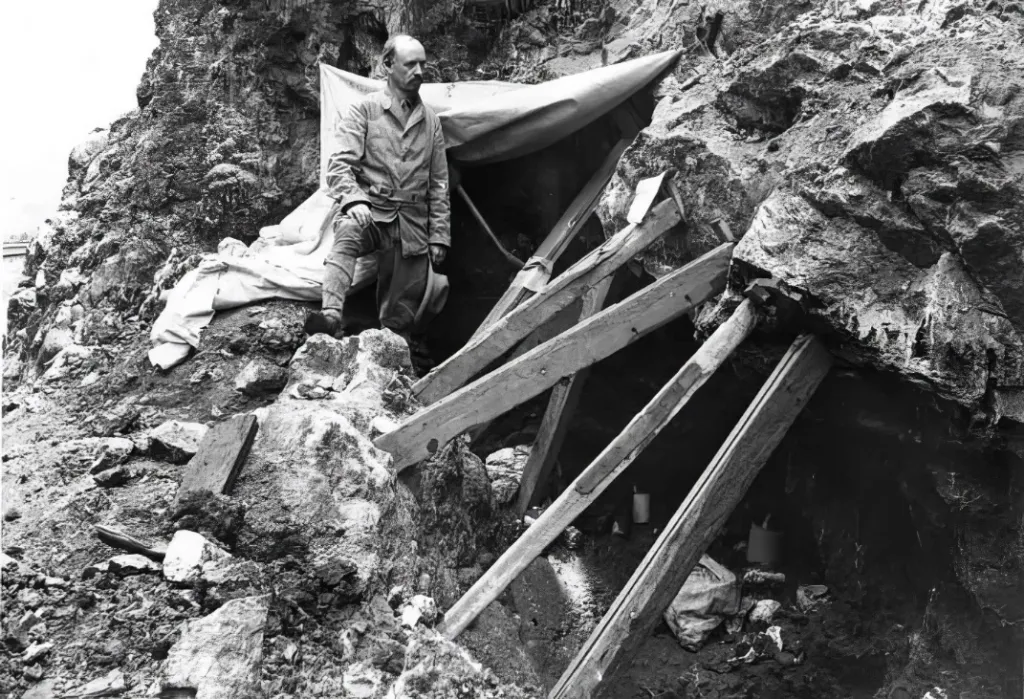 Paleontologist James W. Gidley, posing at the opening of the Cumberland Bone Cave in 1912. Source: 1913 photograph by Raymond William Armbruster, Smithsonian Institution Archives.
Jefferson’s Ground Sloth (Megalonyx jeffersonii)
In the late 1700s, Thomas Jefferson was sent fossil bones from this species that were recovered in a cave in West Virginia. He originally thought the bones belonged to a large cat based on the claw size, but he soon realized that the animal was actually related to South American tree sloths. This Pleistocene mammal was 8-10 ft tall, could weigh up to 2,200 lbs, and walked on all fours. However, it could stand on its hind feet to reach treetops. It was a large herbivore and had a wide range that went from Canada to Mexico. The long claws it sported likely helped it pull down branches to consume rather than for defense. It is believed these critters often sought refuge in caves from predators rather than inhabiting them. Only one site in North America has produced Jefferson’s ground sloth bones that appear to have been butchered by humans, so it is unlikely their extinction was caused by overhunting. Jefferson’s ground sloth is the state fossil of West Virginia.
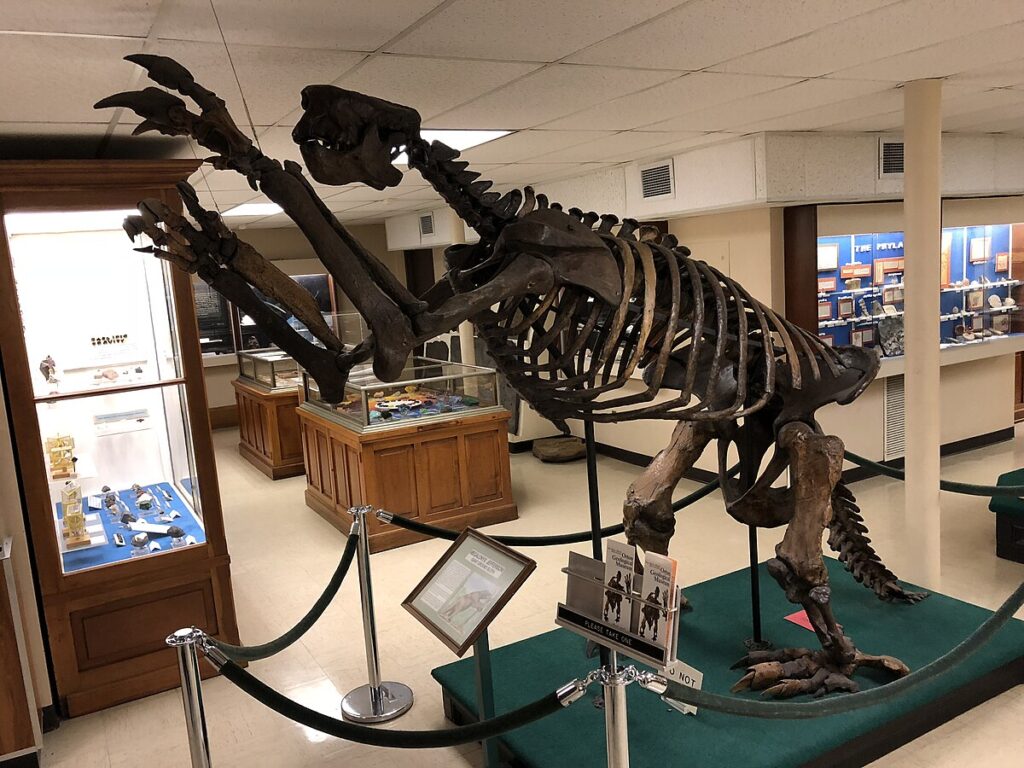 Jefferson’s Ground Sloth by Fuzheado, CC BY-SA 3.0

Gomphotherium calvertensis
Gomphotheres are prehistoric elephants that roamed parts of Maryland. They are also known as wielded beasts due to the presence of 4 long, straight tusks. The earliest fossils for this genus were found in Africa, and the Gomphotherium calvertensis has been found in Miocene deposits along Calvert Cliffs (though they likely got washed away there as this wasn’t a sea-faring critter). A few of the teeth found locally are housed at the Calvert Marine Museum. Gomphotheres had an elongated lower jaw and tough teeth with large ridges that allowed them to chew through branches and leaves (though some species were grazers). By the middle Pliocene, the expansion of grasslands is likely the reason why Gomphotheres in North America dwindled in numbers while their cousins, modern elephants, succeeded with their teeth that were better designed to grind down grasses. These ancient elephant prototypes stood about 10 feet tall and weighed 4-5 tons.
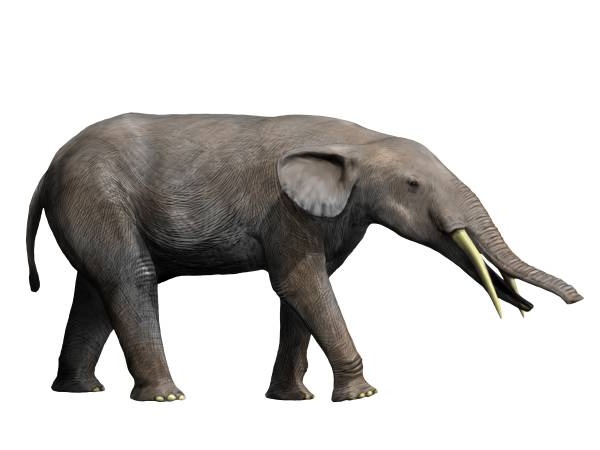 By Nobu Tamura email:nobu.tamura@yahoo.com http://spinops.blogspot.com/ CC BY-SA 4.0
Giant short-faced bear (Arctodus simus)
The giant short-faced bear was a colossal carnivore that could tower more than 11 feet tall when standing and weighed nearly a ton. Fossils from the Cumberland Bone Cave in Allegany County reveal that this Ice Age giant once roamed the hills and valleys of Maryland. With its long legs built for speed and a powerful bite, Arctodus likely dominated the prehistoric landscape, scavenging and competing with saber-toothed cats and dire wolves for prey. Based off its foot and toe shape, this bear could possibly run up to 40mph! Some recent research suggests that giant short-faced bears used their powerful builds moreso to intimidate other predators and cover long distances to scavenge carcasses rather than take down large prey. Though it went extinct about 12,800 years ago, climate change and the loss of its herbivore prey may have sealed its fate.
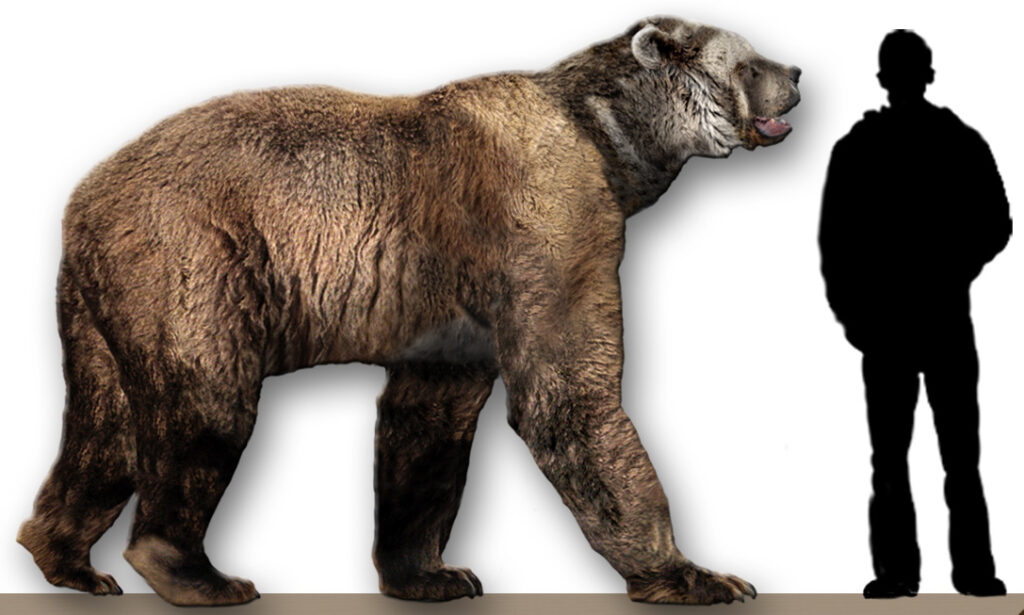 By Dantheman9758 http://dantheman9758.deviantart.com/art/Arctodus-simus-53736084, CC BY-SA 3.0
Sabre-toothed Cat (Smilodon fatalis)
Although commonly referred to as sabre-toothed tigers, these prehistoric felids aren’t closely related to tigers or any modern cat species for that matter. These extinct cats lived in the Americas during the Pleistocene to early Holocene epoch (2.5 mya ~ 8,200 years ago). The sabre-toothed cat was just over 3 feet tall and could weigh over 600 lbs. It had long forelimbs which are believed to be used to hold prey while it delivered a kill bite. Unlike the short-faced bears, sabre-toothed cats were undeniably apex predators. Isotope analysis has revealed this species consumed tapirs, forest bison, and other forest-dwelling mammals. These cats vanished at the end of the Pleistocene along with other megafauna.
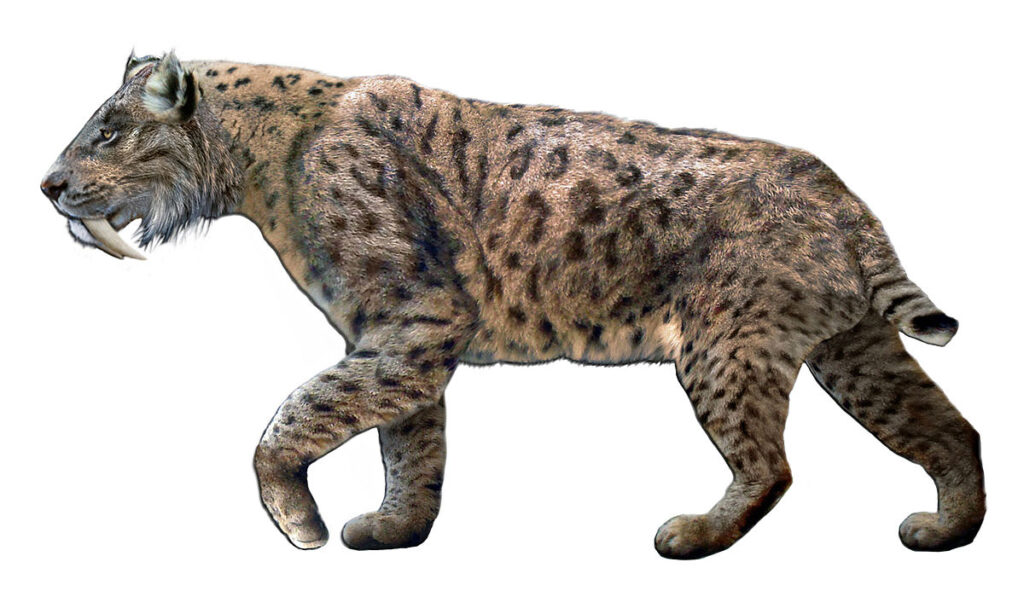 By Dantheman9758 at English Wikipedia, CC BY 3.0
Other fascinating creatures whose fossils have been found in Maryland include the bear-dogs (Amphicyon), long-necked camels (Aepycamelus), the shrub-ox (Euceratherium), and more. You can find a list of prehistoric life in Maryland here.