Bad@ss Babes with Bolas
What if I told you there was a group of spiders in our midst that munch on moths, present themselves as bird poop, and wield their own hand-crafted bolas? Fact or crap? The answer might surprise you!
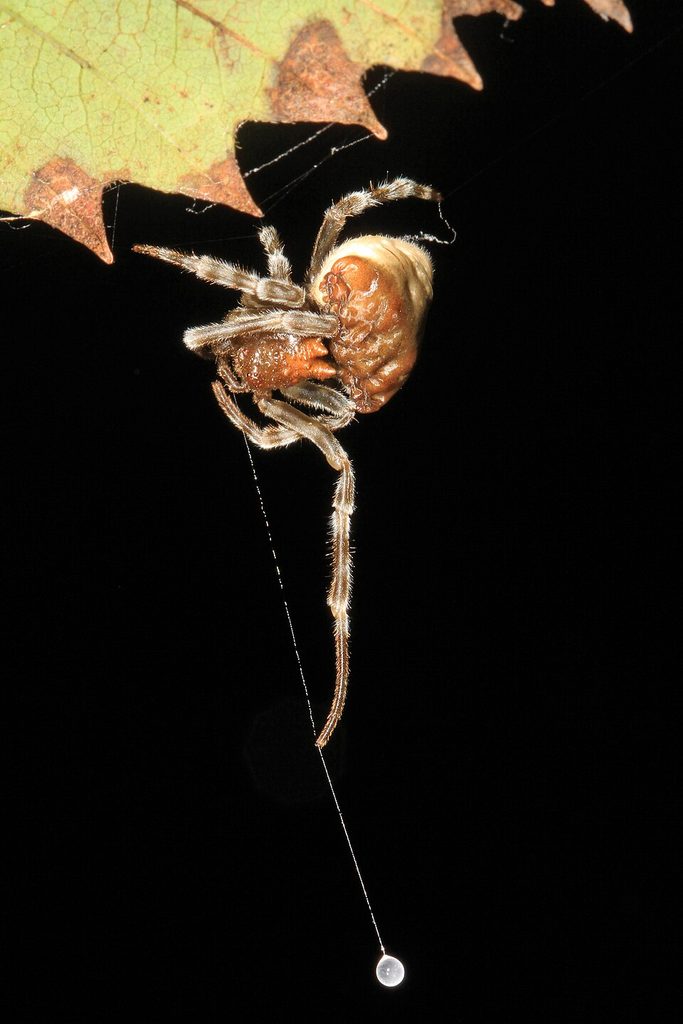
In the Americas, bolas spiders are a group of orb-weaver spiders in the genus Mastophora. They have a special taste for moths which they lure in with a chemical cocktail that resemble pheromones emitted by female moths. The cocktail is added to a sticky ball that the female spider dangles from a silken strand below her (aka the bolas). This concoction is designed to entice male moths which come in for the prospect of mating but end up as dinner instead. On average, the females can catch up to 2 moths per night. One particularly interesting study by Haynes et al. found that the American bolas spider (Mastophora hutchinsoni) will vary the pheromone-mimicking mixtures to attract different moth species. As the night wanes on, the spider will reduce the emission of pheromones used to attract the early flying species to increase their chances of catching the later flying moth species.
Like many other spider species, bolas spider females are much larger than the males. Typically, females are 10-15 mm in size while males are around 2 mm. Unlike the sophisticated hunting techniques of female bolas, males use more primitive forms of hunting by hanging out on the edge of leaves and grabbing whatever comes by.
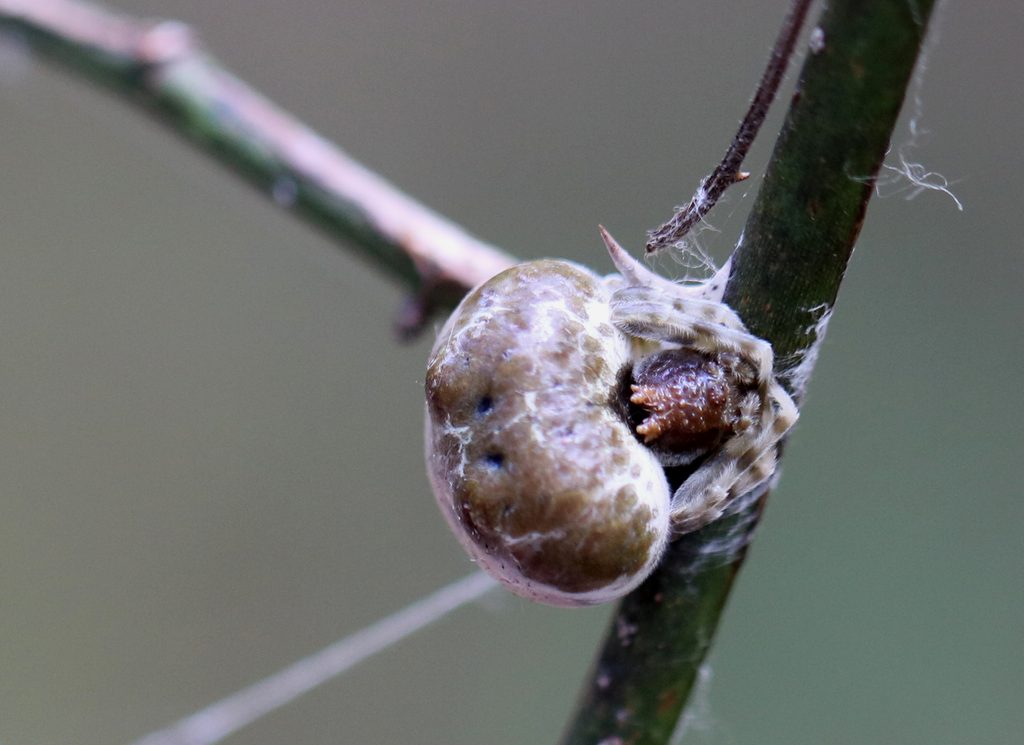
In Maryland, there are 5 species of bolas spiders, and the females of nearly all of them have mastered the art of looking like bird poop on a leaf. They take the disguise a step further by adding silken splotches around their resting spots that mimic the white, uric-acid-rich portions of bird droppings. The only exception is Mastophora timuqua which looks more like a gall than poop. In contrast, male bolas spiders in Maryland are reddish in color.
Although much remains to be learned about local bolas spiders, known species typically mate in late summer or early fall. The fertilized female will lay a camouflaged egg sac, and the adults will die before the first frost. The young hatch in spring, beginning the cycle again.
Locally, one of the best ways to see bolas spiders is to check out one of Bonnie Ott’s fantastic spider walks which she often holds at Howard County Conservancy in September.