
Little Wetland of Horrors
“…at the present moment, I care more about Drosera than the origin of all the species in the world”- Charles Darwin, 1860
Carnivorous plants have always captivated me. It just is wild to think about the evolution of these specialized feeding strategies. It was Charles Darwin that brought to light this adaptation. Once he discovered carnivory in plants (after almost 16 years of study), he was OBSESSED. I completely understand. Since his discovery, we now know that carnivory has evolved multiple times over the 140 million-plus years of flowering plant evolution, independently arising at least 12 times.

In Maryland, we have three types of carnivorous plants- the pitcher plants (Sarracenia), the sundews (Drosera), and the bladderworts (Utricularia). These species typically grow in nutrient-poor environments where the essentials like nitrogen and phosphorus are hard to come by, making invertebrate flesh a decent alternative. Most carnivorous plant species have passive traps, like sticky and/or slick surfaces designed to capture prey. However, the famous Venus flytrap (Dionaea muscipula) and the bladderworts work a little harder with trigger hairs designed to snap or suck up unsuspecting prey.

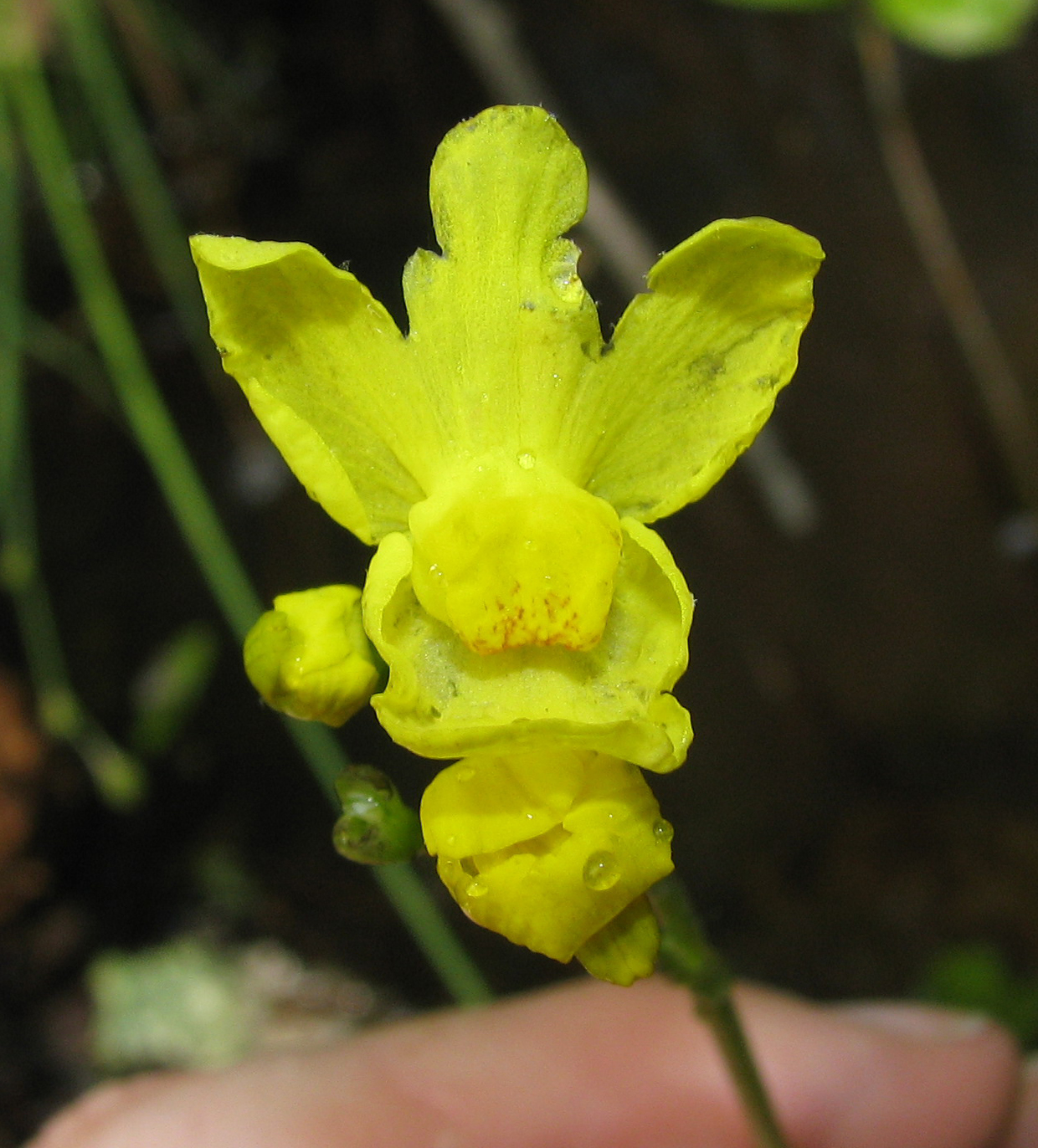
While Venus flytraps get all the fanfare, bladderworts have pretty sophisticated trapping mechanisms. Bladderworts are named for the air-filled sacs (bladders) that are actually modified leaves. Unlike Venus flytraps, bladderworts are found around the world and include over 220 species. In Maryland, twelve bladderwort species have been documented.

Bladderwort traps work by pumping water out of a small bladder, creating low pressure inside and storing energy in the bladder walls. When prey brushes against sensitive trigger hairs, the trapdoor rapidly swings open in just 300–700 microseconds! This motion creates a powerful inward rush of water that pulls the prey into the trap. The trapdoor moves faster than any other known motion in carnivorous plants, giving bladderworts an impressive mechanical advantage over their prey.
Most bladderwort species in Maryland live in slow-mowing water systems like ponds and lakes, while some hang out along the edge of the shore in the wet soil. Almost all bladderworts are insect pollinated, so they keep the ‘eating’ parts well below the flower parts to prevent mixing business with pleasure. One exception is an Australian species that is pollinated by the western spinebill (Acanthorhynchus superciliosus). Typical prey includes rotifers, protozoa, water fleas (Daphnia), and nematodes. Some bigger traps can even capture fish fry and mosquito larvae. Bacteria in the traps are very important for the digestion process and usually help with dissolved organic material and nutrient release. Some species have mutualistic microbes that inhabit the bladders and help the plant with its breakdown of organisms in exchange for some carbon and a free, underwater apartment.
Interestingly enough, algae often ends up in bladderwort traps. For some species, the algae might be an unfortunate bystander sucked into the trap with the intended prey. For others, the algae might form a mutualistic relationship with the bladderwort like bacteria, exchanging nutrients for a place to stay and siphon off other things they need. This area of bladderwort science is still poorly understood.
All in all, these are cool plants in our midst. Keep an eye out for what looks like yellow flowers protruding from the pond surface without obvious leaves. You might be seeing the flowering parts of bladderworts that are working below the surface. A few sites where you might see these cool carnivores include:
- Calvert Cliffs State Park
- Cedarville State Forest
- Cranesville Swamp
- Lake Artemesia Natural Area
- Patuxent Research Refuge
- Piney Orchard Nature Preserve

Alan Winter
Thanks for this! I had no idea that carnivory as a word existed, nor that it evolved convergently a dozen times. Wow.